1. Tiếng Anh lớp 9 Unit 1: Local environment
Từ vựng Unit 1:
| artisan (n) | thợ làm nghề thủ công |
| attraction (n) | điểm hấp dẫn |
| authenticity (n) | thật |
| cast (v) | đúc (đồng…) |
| craft (n) | nghề thủ công, kĩ năng làm nghề thủ công |
| craftsman (n) | thợ làm đồ thủ công |
| cross (v) | đan chéo |
| drumhead (n) | mặt trống |
| embroider (v) | thêu |
| frame (n) | khung |
| handicraft (n) | sản phẩm thủ công |
| lacquerware (n) | đồ sơn mài |
| layer (n) | lợp (lá ...) |
| mould (v) | đổ khuôn, tạo khuôn |
| preserve (v) | bảo vệ, bảo tồn |
| remind (v) | gợi nhớ |
| sculpture (n) | điêu khắc, đồ điêu khắc |
| set off (ph.v) | khởi hành |
| strip (n) | dải |
| surface (n) | bề mặt |
| team-building (adj) | xây dựng đội ngũ |
| thread (n) | sợi |
| treat (v) | xử lí (chất thải ...) |
| turn up (ph.v) | xuất hiện, đến |
| weave (v) | đan (rổ, rá...), dệt (vải...) |
| workshop (n) | công xưởng, xưởng |
Getting Started (phần 1-3 trang 6-7 SGK Tiếng Anh 9 mới)
1. Listen and read (Nghe và đọc)
Nội dung bài nghe:
Nick: There are so many pieces of pottery here, Phong. Do your grandparents make all of them?
Phong: They can't because we have lots of products. They make some and other people make the rest.
Nick: As far as I know, BatTrang is one of the most famous traditional craft villages of Ha Noi, right?
Phong: Right. My grandmother says it's about 700 years old.
Mi: Wow! When did your grandparents set up this workshop?
Phong: My great-grandparents started it, not my grandparents. Then my grandparents took over the business. All the artisans here are my aunts, uncles, and cousins.
Mi: I see. Your village is also a place of interest of Ha Noi, isn't it?
Phong: Yes. People come here to buy things for their house. Another attraction is they can make pottery themselves in workshops.
Nick: That must be a memorable experience.
Phong: In Viet Nam there are lots of craft villages like Bat Trang. Have you ever been to any others?
Mi: I've been to a conical hat making village in Hue!
Nick: Cool! This is my first one. Do you think that the various crafts remind people of a specific region?
Mi: Sure. It's the reason tourists often choose handicrafts as souvenirs.
Phong: Let's go outside and look round the village.
a. Can you find a word/phrase that means: (Tìm từ hoặc cụm từ có nghĩa sau:)
1. a thing which is skillfully made with your hands
2. start something (a business, an organisation, etc.)
3. take control of something (a business, an organisation, etc.)
4. people who do skilled work, making things with their hands
5. an interesting or enjoyable place to go or thing to do
6. a particular place
7. make someone remember or think about something
8. walk around a place to see what is there
| 1. craft | 2. set up | 3. take over | 4. artisans |
| 5. attraction | 6. specific region | 7. remind | 8. look around |
b. Answer the following questions. (Trả lời các câu hỏi)
- Where are Nick, Mi, and Phong?
⇒ They are at Phong's grandparents' pottery workshop in Bat Trang.
2. Write the name of each traditional handicraft in the box under the picture. (Viết tên mỗi đồ thủ công truyền thống vào chỗ trống bên dưới tranh.)
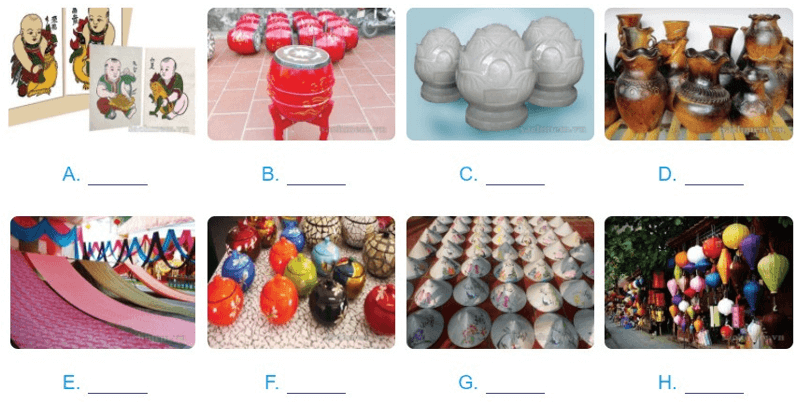
Đáp án:
| a. paintings | b. drums | c. marble sculptures | d. pottery |
| e. silk | f. lacquerware | g. conical hats | h. lanterns |
3. Complete the sentences with the words/ phrases from 2 to show where in Viet Nam the handicrafts are made. You do not have to use them all. (Hoàn thành những câu sau bằng các từ hoặc cụm từ ở bài 2 để xem những đồ thủ công được làm ở nơi nào của Việt Nam. Bạn không cần dùng tất cả các từ.)
1. The birthplace of the famous bai tho___________ is Tay Ho village in Hue.
2. If you go to Hoi An on the 15th of each lunar month, you can enjoy the lights of many beautiful___________.
3. Van Phuc village in Ha Noi produces different types of ___________products such as cloth, scarves, ties, and dresses.
4. On the Tet holiday, many Hanoians go to Dong Ho village to buy folk___________.
5. ___________products of Bau Truc, such as pots and vases, have the natural colours typical of Champa culture in Ninh Thuan.
6. Going to Non Nuoc marble village in Da Nang, we're impressed by a wide variety of___________from Buddha statues to bracelets.
2. Tiếng Anh lớp 9 Unit 2: City life
Từ vựng Unit 2:
| fabulous (adj) | tuyệt vời, tuyệt diệu |
| reliable (adj) | đáng tin cậy |
| metropolitan (adj) | (thuộc về) đô thị, thủ phủ |
| multicultural (adj) | đa văn hóa |
| variety (n) | sự phong phú, đa dạng |
| grow up (ph.v) | lớn lên, trưởng thành |
| packed (adj) | chật ních người |
| urban (adj) | (thuộc) đô thị, thành thị |
| Oceania (n) | châu Đại Dương |
| medium-sized (adj) | cỡ vừa, cỡ trung |
| forbidden (adj) | bị cấm |
| easy-going (adj) | thoải mái, dễ tính |
| downtown (adj) | (thuộc) trung tâm thành phố, khu thương mại |
| skyscraper (n) | nhà cao chọc trời |
| stuck (adj) | mắc kẹt, không di chuyển được |
| wander (v) | đi lang thang |
| affordable (adj) | (giá cả) phải chăng |
| conduct (v) | thực hiện |
| determine (v) | xác định |
| factor (n) | yếu tố |
| conflict (n) | xung đột |
| indicator (n) | chỉ số |
| asset (n) | tài sản |
| urban sprawl | sự đô thị hóa |
| index (n) | chỉ số |
| metro (n) | tàu điện ngầm |
| dweller (n) | cư dân |
| negative (adj) | tiêu cực |
| for the time being | hiện thời, trong lúc này |
Unit 2 lớp 9: Getting started (phần 1 - 2 trang 16 - 17 SGK Tiếng Anh lớp 9 mới)
1. Listen and read (Nghe và đọc)
Nội dung bài nghe:
Paul: Hi, Duong! How's it going? Getting over the jet lag?
Duong: Yes, I slept pretty well last night. Hey, thanks so much for showing me around today.
Paul: No worries, it'll be good fun.
Duong: So, are you from around here?
Paul: Me? Yes, I was born and grew up here. Sydney's my hometown.
Duong: It's fabulous. Is it an ancient city?
Paul: No, it's not very old, but it's Australia's biggest city, and the history of our country began here.
Duong: Wow! So what are the greatest attractions in Sydney?
Paul: Well, its natural features include Sydney Harbour, the Royal National Park, and Bondi Beach. Man-made attractions such as the Royal Botanic Gardens, Sydney Opera House, and the Harbour Bridge are also well known to visitors.
Duong: What about transport?
Paul: Public transport here is convenient and reliable: you can go by bus, by train, or light rail. Taxis are more expensive, of course.
Duong: And is Sydney good for shopping?
Paul: Of course! You know, Sydney's a metropolitan and multicultural city, so we have a great variety of things and foods from different countries. I'll take you to Paddington Market later, if you like.
Duong: Wonderful. What about education? Are there many universities?
Paul: Sydney has five big universities and some smaller ones. The oldest of them was set up in 1850, I believe.
Duong: Oh, it sounds like a good place to get higher education. I like this town!
a. Complete the sentences with information from the conversation (Hoàn thành câu với những thông tin từ đoạn hội thoại.)
1. It is Duong's first ________ to Sydney.
2. In Paul's opinion, Sydney is not an ________ city.
3. Sydney Harbour is a ________ attraction of Sydney.
4. The shopping is good because of the ________ of things.
5. Duong thinks Sydney may be a good place to ________.
Đáp án:
| 1. visit | 2. ancient | 3. natural | 4. variety | 5. study |
b. Find words in the conversation to match these definitions (Tìm từ trong đoạn hội thoại thích hợp với các định nghĩa sau.)
1. tiredness from travelling across different time zones
2. an attraction
3. that can be trusted
4. belonging to a very large city
5. including people of different races, religions, languages, and traditions
Đáp án:
| 1. jet lag | 2. a feature | 3. reliable | 4. metropolitan | 5. multicultural |
c. Answer the questions. (Trả lời câu hỏi.)
1. Where did Paul grow up?
2. What is the biggest city in Australia?
3. How is the public transport in Sydney?
4. Why is there a great variety of things and foods in Sydney?
5. When was the first university built in Sydney?
Đáp án:
1. Sydney.
2. Sydney.
3. Public transport in Sydney is convenient and reliable.
4. Because Sydney is a metropolitan and multicultural city.
5. In 1850.
2. Replace the word(s) in italics with one of the words from the box. (Thay thế những từ in nghiêng bằng các từ sau.)
1. There is not a lot of world _________ news in this newspaper.
2. I do my shopping in the neighbourhood _________ shops, not in the town centre.
3. At weekends the city centre is always packed _________ with people.
4. My friend's family has just moved to a nearby _________ town.
5. There is far too much pollution nowadays in city _________ areas.
Đáp án:
| 1. international | 2. local | 3. crowded | 4. neighbouring | 5. urban |
3. Tiếng Anh lớp 9 Unit 3: Teen stress and pressure
Từ vựng Unit 3
| Word | Meaning |
|---|---|
| Tense (adj) | Căng thẳng |
| Adolescence (n) | Giai đoạn vị thành niên |
| Calm (adj) | Bình tĩnh |
| Cognitive (adj) | Thuộc về tư duy |
| Concentrate (v) | Tập trung |
| Confident (adj) | Tự tin |
| Delighted (adj) | Vui sướng |
| Depressed (adj) | Chán nản |
| Embarrassed (adj) | Xấu hổ |
| Emergency (n) | Tình huống khẩn cấp |
| Frustrated (adj) | Bực bội |
| Let out (v) | Cảm thấy bị bỏ rơi |
| Relaxed (adj) | Thư giãn, thoải mái |
| Worried (adj) | Lo lắng |
| Self-aware (adj) | Tự nhận thức |
| Risk taking (adj) | Liều lĩnh |
| Take a break (v) | Nghỉ ngơi |
| Disappoint (v) | Làm thất vọng |
| Emphasise (v) | Thông cảm, đồng cảm |
| Helpline (n) | Đường dây cứu trợ |
Unit 3 lớp 9: Getting started (phần 1-2 trang 26-27 SGK Tiếng Anh lớp 9 mới)
1 Listen and read (Nghe và đọc)
Nội dung bài nghe:
Amelie: Hi Phuc! Where’s Mai? Isn’t she coming?
Phuc: She said she was too tired and didn’t want to go out. She’s been staying up late studying for the exam.
Nick: Does she need to be that stressed out?
Phuc: Maybe not. But my parents always expect her to get good grades and she doesn’t want to disappoint them. They want her to go to a top college and study medicine.
Amelie: Really? She told me she wanted to be a designer…
Phuc: Yes, that’s why she’s been a bit tense lately. She doesn’t know what to do. My parents said design graduates wouldn’t find jobs easily and they wanted her to get a medical degree.
Amelie: Oh, I understand. Sometimes I wish my parents could put themselves in my shoes…
Nick: Anyway, Mai needs to take a break. I’ll call and ask her if she wants to go and see a film with us tomorrow.
Phuc: Oh, I doubt it... She’s already fully booked for the weekend with her maths class, English class, judo class, and music lesson!
a. Find the OPPOSITE of the following words in the conversation. (Tìm từ trái nghĩa với các từ bên dưới trong đoạn đối thoại.)
1. to go to bed early >< to stay up late
2. to be relaxed >< to be tense
3. bad exam results >< good grades
4. to make someone happy >< to disappoint someone
5. to work continuously >< to take a break
6. to have no plans >< to book for
b. Choose the best answer. (Chọn đáp án đúng nhất.)
1. Why is Mai not playing badminton with Phuc, Nick, and Amelie?
A. She doesn't like playing badminton.
B. She is late.
C. She wants to stay at home.
2. Why is Mai working very hard for the exam?
A. She failed the last exam.
B. She wants her parents to be proud of her.
C. She wants to compete with her classmates.
3. How is Mai feeling now?
A. Confident and tired
B. Tense and disappointed
C. Tired and stressed
4. What do Mai's parents want her to be?
A. A medical doctor B. A designer C. A musician
5. What does Mai want to be?
A. A medical doctor B. A designer C. A musician
6. What are Phuc, Nick, and Amelie trying to do?
A. Understand Mai's situation and help her feel better.
B. Make Mai feel left out.
C. Find somebody else to replace Mai for the badminton.
Đáp án:
| 1. C | 2. B | 3. C | 4. A | 5. B | 6. A |
c. What do you think Amelie means when she says, 'Sometimes I wish my parents could put themselves in my shoes'? (Amelie nói "Thỉnh thoảng mình ước là bố mẹ có thể đặt họ vào vị trí của mình?" nghĩa là gì?)
Amelie wishes her parents could put themselves in her situation to better understand her.
2. Fill the gaps with the words in the box. In some cases more than one word may be suitable. (Điền từ vào chỗ trống. Một số trường hợp có thể sử dụng nhiều hơn 1 lần.)
1. Thu had been studying very hard for the exam, but she still felt ___________. Now that she has done well in the exam she is feeling much more ___________.
2. My mother is a strong person. She stays ___________ even in the worst situations.
3. Linh is feeling a bit ___________ about her study. She's failed the exam once again!
4. I think taking a speech class is a good idea if you want to be more ___________.
5. Emma is feeling so ___________ with her fashionable new hairstyle.
6. Phuc, Nick, and Amelie feel ___________. They want to help Mai but don't know what they can do for her.
Gợi ý:
1. worried/tense/stressed; relaxed/confident.
2. calm.
3. depressed/frustrated/stressed.
4. confident/relaxed/calm.
5. delighted/confident.
6. worried.
Xem thêm: Tổng hợp tất cả công thức Tiếng Anh lớp 9 mới nhất